


What is slurry seal?
Asphalt road surfaces deteriorate over time and under the influence of various weather factors such as rainfall, frost, sunlight, and the abrasive effects of vehicle wheels, ice-breaking tires, and other factors. To prevent severe wear and tear and deterioration of road surfaces, it is necessary to continuously monitor the extent of the damage. Failure to pay attention to it will aggravate this damage and spread it to other layers, ultimately leading to the complete destruction of the pavement and road body. The useful life of any asphalt depends on the quality of its construction and the materials used during its construction, although heavy traffic and the number of passing traffic are also indicators of its continued use over time.
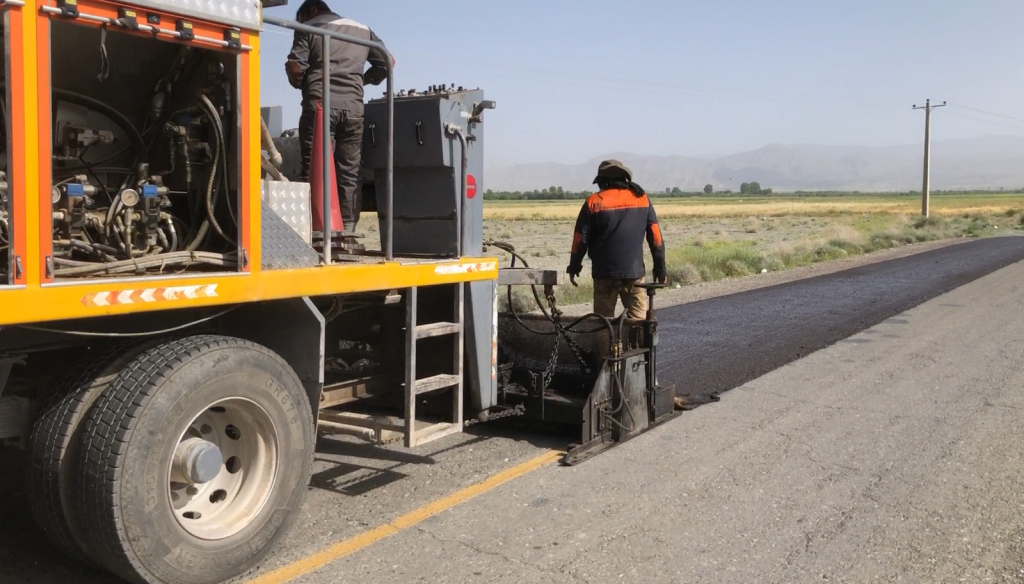
In order to delay road damage, various road maintenance and repair methods are used. The choice of these methods directly depends on the extent of damage and its type. Timely repair and modification of the asphalt surface prevents its further expansion and preserves the asphalt surface and even the base and sub-base layers.
Timely repair of the asphalt surface prevents financial losses and additional costs, and instead of resurfacing, the road surface can be repaired with cheaper methods and save a lot of money.
One of the protective asphalts and methods of maintaining and repairing the asphalt surface of roads is the Slurry Seal method. Slurry seal mixtures are made from well-graded, continuous, coarse, and clean materials that are free of contamination, water, mineral fillers, or additives that are uniformly mixed with a type of bitumen emulsion. Mineral fillers such as Portland cement that has passed a 200 mesh screen when combined with bitumen emulsion, although they increase the time in the production process, but after spreading, they cause the water of the emulsion to be absorbed more quickly due to its breakdown.
Sometimes, slurry seal is considered a temporary surface coating that is used to increase the life of the existing pavement by preventing oxygen and sunlight from coming into contact with the original pavement.
To have a surface of optimal quality, it is necessary to ensure that the pavement is dry and clean and that all repair and maintenance work has already been completed before applying slurry seal. In hot conditions and in the presence of sunlight, spreading a thin layer of water on the surface is necessary to control the premature breakdown time of the emulsion and improve the adhesion of slurry seal to the existing pavement.
Regarding the application time in different weather conditions, it is better to apply slurry seal when the air temperature is at least 10 degrees Celsius and warmer, and there is no possibility of frost during the first 24 hours after application. It is also important to note that slurry seal should not be applied during rain or when there is a possibility of rain before the emulsion has fully set. In hot weather, the minimum time required for slurry seal to set is two hours, and the total setting time of slurry seal depends on factors such as ambient air temperature, humidity, and the type of bitumen emulsion used.
It is not appropriate to use slurry seal on routes that require rapid reopening to traffic.
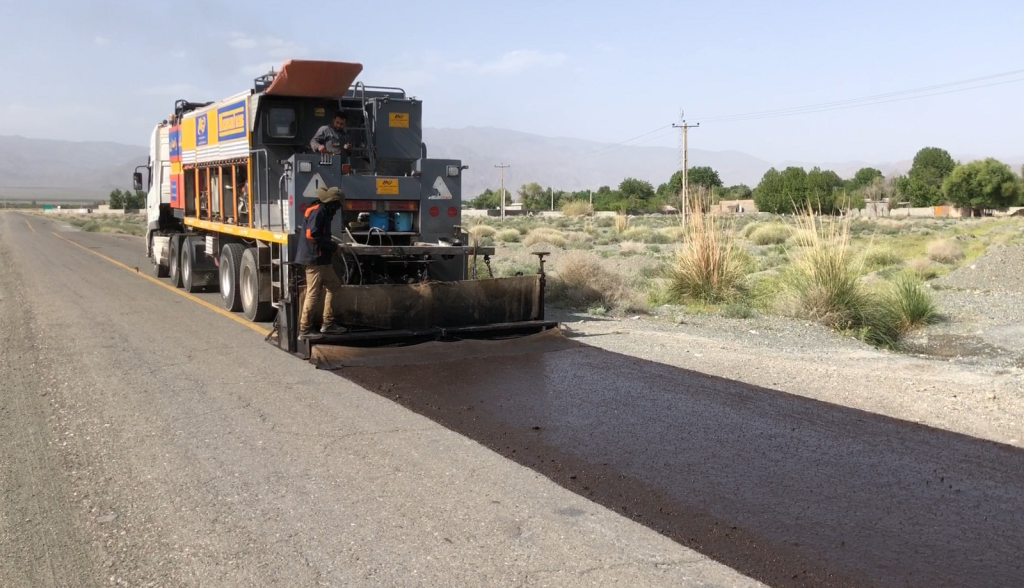
Slurry Seal is applied to the road surface as a liquid to paste slurry by special slurry seal machines. The emulsion bitumen breaks on the road surface and the asphalt particles and materials stick together and form a resistant layer. Applying a slurry seal protective coating does not increase the load-bearing capacity of the asphalt and is only known as a coating layer. A small amount of water causes the mixture to harden and not adhere to the previous surface, and a large amount causes it to flow before adhering to the road surface. The speed of the mixing machine can be from one to four kilometers per hour.
Finally, it is important to mention that the factors that affect the performance of slurry seal include traffic volume, environmental conditions, existing pavement conditions, mixing design and mix quality, and the method of application. In this regard, it should be noted that slurry seal should not be used on roads with high traffic volumes, as the coefficient of surface friction may decrease due to the use of fine-grained materials in rainy conditions. It should be noted that slurry seal will not perform well in areas where the existing pavement is very cracked and has lizard cracks, and it can only be used if there is a stable pavement with low-intensity cracks.
The difference between slurry seal and microsurfacing is the presence of polymer-modified emulsion bitumen, which increases the useful life of the coating and, of course, increases its costs. The added polymer reduces the sensitivity to heat in the asphalt and corrects the soft point of the pavement, which increases its resistance compared to slurry seal. Usually, the useful life of slurry seal is between three and five years. If all of the above is observed and the technical specifications are controlled, its useful life can be increased.
What applications is slurry seal suitable for?
1- Roads and streets whose pavement is not completely destroyed and does not have major defects and subsidence such as lizard cracks and the like.
2- In applications where bitumen and asphalt are oxidized.
3- In applications where the sand grains of the road surface are being peeled off and the road surface is excessively rough.
4- To cover cracks